LA QUEDADA. STUDIO VISIT. ART MADRID'25
Feb 24, 2025
art madrid
LA QUEDADA. STUDIO VISIT. ART MADRID'25
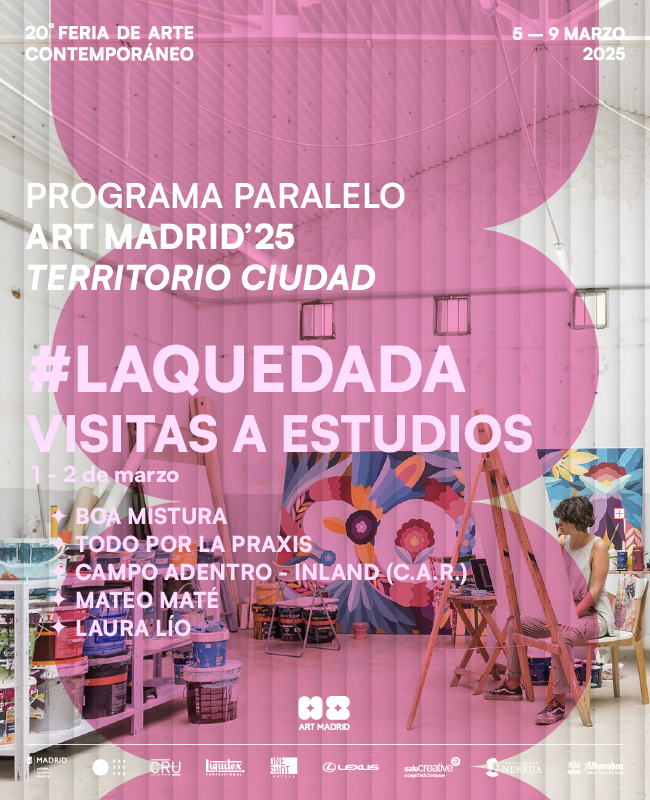
Art Madrid invites you to #LaQuedada!
To celebrate our twenty years of contemporary art, we have organized a parallel program of activities under the theme "City Territory," which focuses on public space, the city, and territory as central elements of artistic practices. This program will include events throughout February and during Madrid Art Week at the Galería de Cristal of the Cibeles Palace.
Together with CRU, we have organized the second edition of #LaQuedada on March 1st and 2nd, a circuit of artist studio tours.
Have you ever wondered what an artist’s workspace looks like? Or where an artist creates their work, for example, when preparing for an art fair? The event is open to both professionals and the general public. During the sessions, we will explore five spaces dedicated to artistic creation and architectural project development, all connected by the concept of utopia, a concept that unites utopian architectures, spaces for care, and decentralized actions that can be built between centers and peripheries.
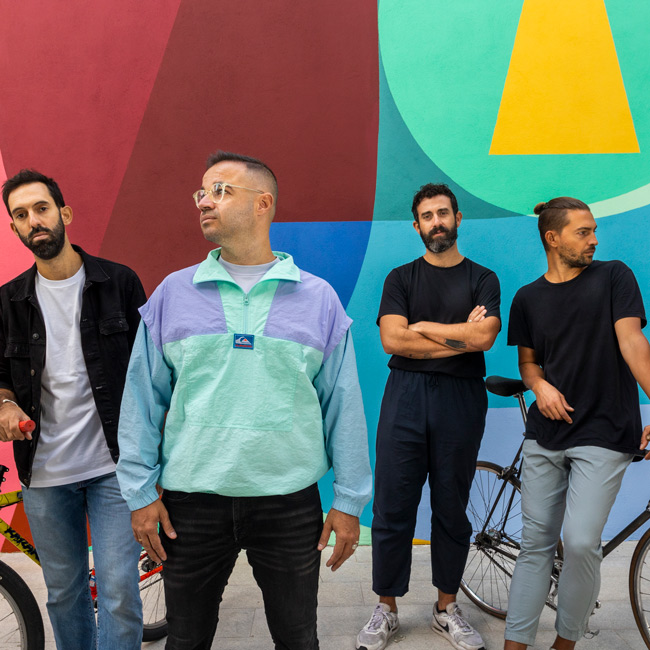
STUDIO VISIT WITH BOA MISTURA
When: Saturday, 1 March. 16:30h
ABOUT BOA MISTURA
Boa Mistura is an artistic collective with roots in graffiti, born in Madrid at the end of 2001. It is made up of the Fine Arts graduates Pablo Ferreiro and Juan Jaume, the visual artist Rubén Martín de Lucas, the illustrator Pablo Purón and the architect Javier Serrano. Pablo Ferreiro, Pablo Purón and Javier Serrano are still active today. The term ‘good mix’ refers to the symbiosis between its members.
Their work is mainly developed in the public space. They conceive their work as a transforming element, capable of creating or modifying people's relationships with the place where they live, as well as the ties that exist between them.
They have carried out projects in more than 40 countries around the world, collaborating with organisations such as the UN, Amnesty International, UNDP, Greenpeace, Action Against Hunger and the Red Cross, among many others.
Their work has been part of the Ibero-American Design Biennial - IDB 2024 and 2020, the Dakar Biennial 2022, the Shen Zhen Urban Biennial 2017, the Cali Mural Painting Biennial 2016, the Havana Art Biennial 2015, the Milan Design Triennial 2015, the Architecture and Urbanism Biennial - BIAU 2015 and the Venice Architecture Biennial 2012 in the Spanish Pavilion.
They have participated in exhibitions and shows in important art centres, such as the Reina Sofía Museum in Madrid, the MAXXI Museum in Rome, the Hyundai Museum ALT1 in Seoul, the CAC in Malaga, the Palace of Fine Arts in Santo Domingo, the CENTREQUATRE in Paris, the Casa Encendida in Madrid, the CONDEDUQUE Contemporary Culture Centre, the Alcobendas Art Centre, the Welt Museum in Vienna and the Bauhaus-Archiv in Berlin.
His work methodology has been recognised with a bronze medal at the UN-Habitat + World Habitat World Habitat Awards 2018.
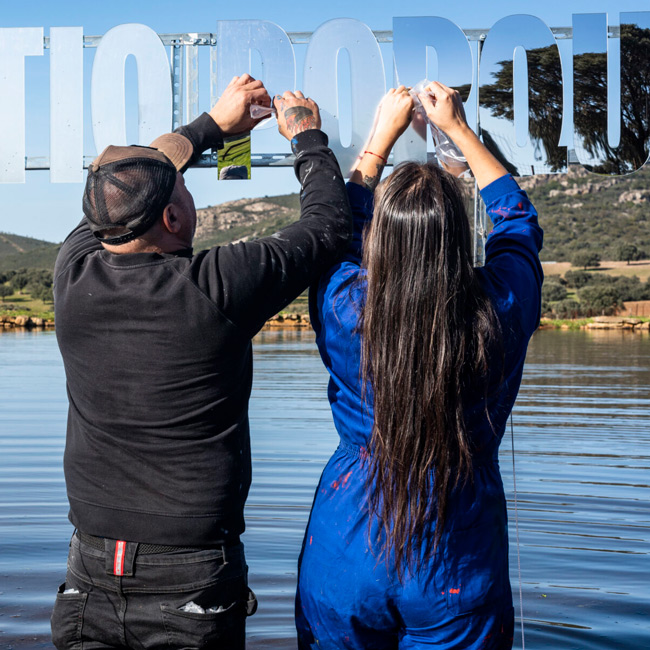
STUDIO VISIT WITH TODO POR LA PRAXIS
When: Saturday, 1 March. 18:30h
ABOUT TODO POR LA PRAXIS
Art and critical architecture collective founded in 2008, whose main focus is the social function of art and direct action. Its aim is to activate artistic practice as a contribution to transformation, creating spaces and devices for critical reflection. The imaginaries they construct address diverse dissidence and political resistance through collaborative practices, based on the amplification of narratives that intervene in public space. It is currently made up of the artist and architect Diego Peris López, and the visual artist and researcher Jo Muñoz.
The various works that make up their practice seek to construct other possible imaginaries, analysing current contexts from the challenge of creating, approaching and embracing radical discourses, antagonistic to hegemonic cultural impositions. They seek to install knowledge and spaces for critical thinking, activating new transcultural subjectivities as a decolonisation of dominant thought. They carry out processes of research, production and action in both geographical and symbolic territories, using agitprop, counter-advertising and the visibiliation or guerrilla of communication, in critical devices that question aesthetic and political narratives.
Their works have been exhibited in more than 35 exhibitions curated by various curators in Spain and internationally. In addition, they have been published in several magazines and interviews, received awards and have been in artistic residencies. During 2024 they are awarded the VEGAP grant, and have been selected for the City of Palma Antoni Gelabert visual arts prize.
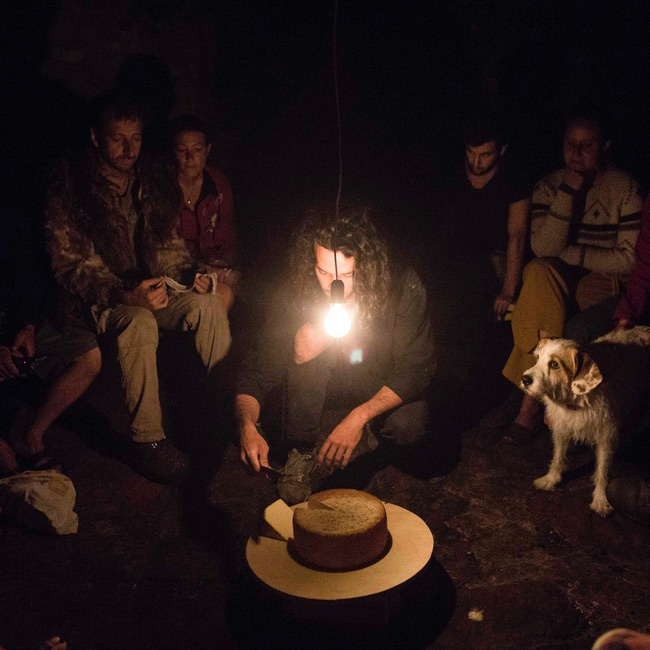
VISIT THE CAMPO ADENTRO - INLAND SPACE
When: Sunday, 2 March. 13:00h
ABOUT C.A.R.
The Centro de Acercamiento a lo Rural (CAR) is a project of Campo Adentro, launched in October 2018. The house is Campo Adentro's headquarters in the city and functions as a dynamic and inclusive space where we seek the encounter between the rural and the urban, making visible and catalysing creative and social processes. At CAR we combine research, training and cultural production through different lines of action, from a documentation centre to a canteen or a self-publishing workshop. It aims to be a window for the urban artistic community to what is happening in the countryside, a home for rural agents, artists, researchers and different people who are temporarily linked to CAR to develop their lines of work.
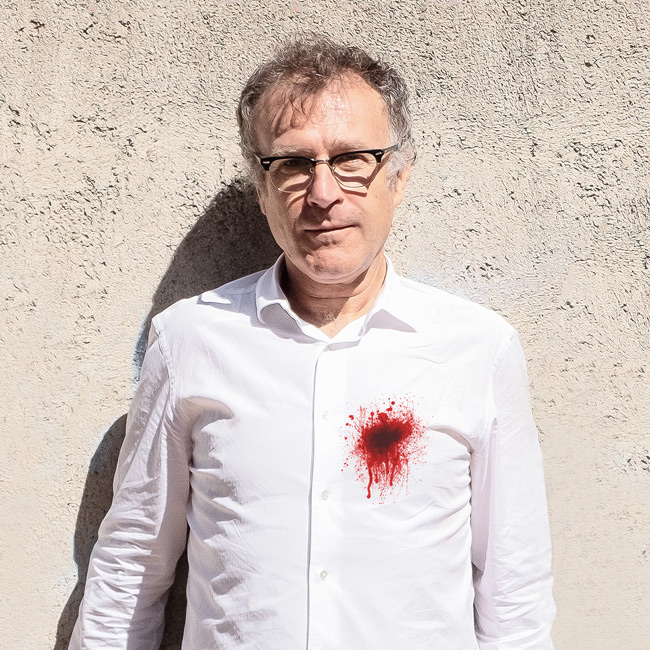
STUDIO VISIT WITH MATEO MATÉ
When: Sunday, March 2. 17:00h
ABOUT MATEO MATÉ
Mateo Maté (1964) has held solo exhibitions at the Ulsan Art Museum (South Korea, 2023), the Weserburg Museum (Bremen, 2021), the Galleria Nazionale d'Arte Moderna (Rome, 2020), the Isabel Aninat Gallery (Santiago de Chile, 2018), Sala Alcalá 31 (Madrid, 2017), Max Weber Six Friedrich Gallery (Munich, 2014), the Lázaro Galdiano Museum, the Cerralbo Museum, the National Library of Spain, and the Museum of Romanticism (Madrid, 2013), the Museo Nacional Centro de Arte Reina Sofía (Madrid, 2012), the Siqueiros Museum (Mexico City, 2011), Matadero (Madrid, 2010), the Patio Herreriano Museum (Valladolid, 2008), and the Grita Insam Gallery (Vienna, 2005-08), among others.
His work has also been exhibited in the following national and international museums and art centers: Centro Botín (Santander, 2020), Centro de Arte 2 de Mayo (Madrid, 2020), Artium (Vitoria, 2018), Museo Thyssen-Bornemisza (Madrid, 2017), Miró Foundation (Barcelona, 2015), MART (Trento, 2014), La Nuit Blanche (Paris, 2014), Hirshhorn Museum (Washington, 2014), Tàpies Foundation (Barcelona, 2013), The Herzliya Museum (Tel Aviv, 2012), Museum of Contemporary Art (Santiago de Chile, 2012), Berardo Museum (Lisbon, 2011), BOZAR (Brussels, 2010), Jeu de Paume (Paris, 2007), PS1 MoMA (New York, 2003), among many others.
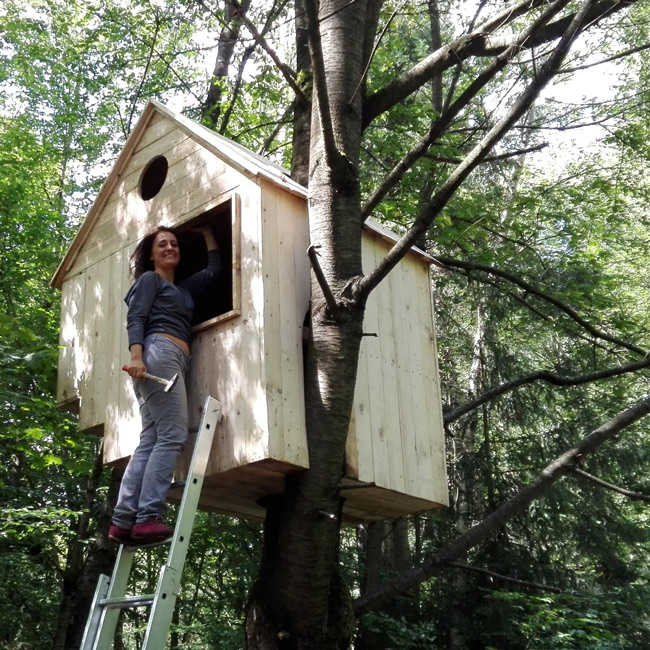
STUDIO VISIT WITH LAURA LÍO
When: Sunday, 2 March. 19:30h
ABOUT LAURA LÍO
Laura Lío is dedicated to research and creation in the visual arts. She was born in 1967 in Buenos Aires, Argentina and has lived in Madrid since 1990. She studied at the Escuela Superior de Bellas Artes 'Ernesto de la Cárcova' in Buenos Aires and at the Faculty of Fine Arts of the UCM. She holds a Doctorate in Fine Arts from the University of Castilla-La Mancha (2012). Her book Esporas (ed. DOSPAREDESY1PUENTE, Madrid) will be published in 2022 and her essay Refugios del cuerpo y la imaginación. Biomímesis en arte y arquitectura desde las construcciones de los animales (published by Asimétricas, Madrid). He has made sculptures, installations, projects for specific spaces and has worked extensively on paper in drawing, graphics and artists' books. In 2015 he founded PEZPLATA Ediciones, an imprint for artists' books and printed matter, based in his NavEstudio in Madrid.
Her work has been published in numerous catalogues and books. In 1997 she was awarded a scholarship from the Spanish Academy in Rome and in 1998 a scholarship for creation in the plastic arts from the College of Spain in Paris. In 2005 she received a grant from the Rockefeller Foundation in New York to live at the Bellagio Study and Conference Centre. In 2006 he received the Endesa Grant for Visual Arts from the Diputación de Teruel and in 2013 a residency grant from the Bogliasco Foundation in Italy, as well as a grant from the Mexican government. In 2016 he carried out a creative residency in China, a project organised by the Calcografía Nacional and the Instituto Cervantes in Beijing. In 2018 she participated in the Art meets Science project in Harlösa, Sweden, with the ARNA organisation. In 2024 she participated in the Involving cultural Actors meeting in Brussels, representing the Spanish arts sector in the European Parliament.
To date he has participated in 22 solo exhibitions in Spain, Argentina, France, Italy and other countries, most recently at the Palacio Quintanar in Segovia, the CAB in Burgos and the Artur Ramón Gallery in Barcelona. His work has also been included in important group exhibitions such as El retorno de lo imaginario. Realismos entre el XIX y el XXI, held at the Museo Reina Sofía in 2010, and Printed Matter, held at the MoMA in 2018. Several of his sculptures can be found in public spaces such as O Grove (Pontevedra, Spain), the Odenwald (Darmstadt, Germany), the Franco Basaglia Centre (Livorno, Italy) and in Strömsfors, Sweden.
Her sculptures and drawings are in public and private collections such as the Museo Nacional Centro de Arte Reina Sofía, Museo Municipal de Arte Contemporáneo de Madrid, Museo del Patio Herreriano, Ministerio de Asuntos Exteriores, Congreso de Diputados, Colección de Arte Contemporáneo Unión Fenosa, Biblioteca Nacional de España, Ministerio de Cultura, Colegio de España en París, Caja Madrid-Obra Cultural, Fundación Endesa, Museo de Teruel, Academia Española de Historia, Arqueología y Bellas Artes de Roma, Archivo Lafuente and the Circa XX Collection, among others.
During the visit, we will project his piece Hacer la calle. Lo digo con un cartel (7")