Art Madrid'26 – SUNCITYBOY: THE EMPIRE OF THE EMOJI

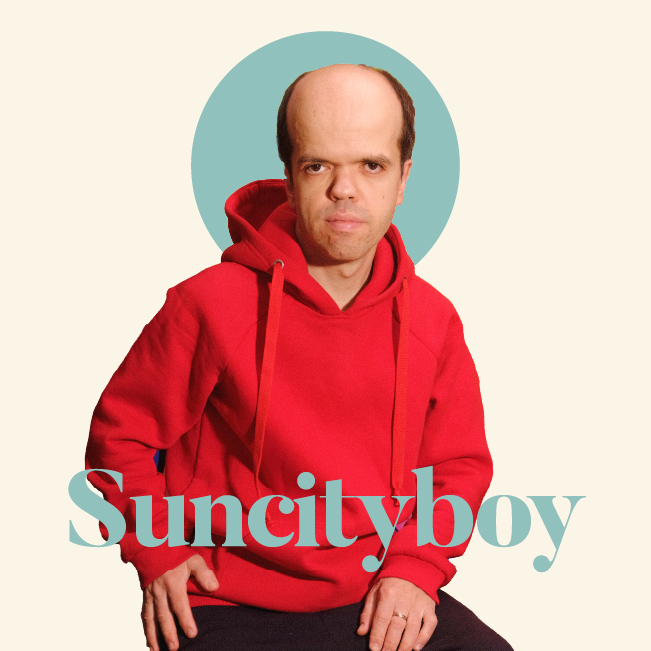
Suncityboy. Courtesy of the artist.

ARTE & PALABRA. CONVERSATIONS WITH CARLOS DEL AMOR

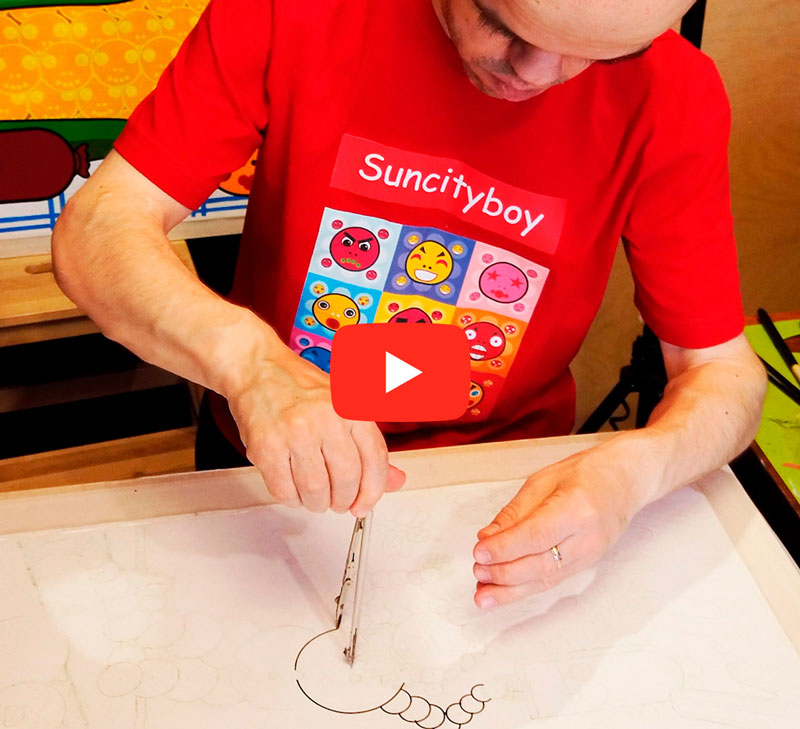
It is always difficult to create one's own universe, this complication increases when this universe is populated by characters known and recognized by all, who are part of the imagination of many, inventing on what already exists is doubly difficult. Suncityboy (Tver, Russia, 1984) has invented a world inhabited by fairy tale characters and cultural icons who share a common denominator: they are formed by small balls that assemble an impossible body with an emoji face and, despite the initial strangeness, immediately evoke empathy and familiarity.

Color overflows all its scenes and we meet Alice in Wonderland (or more precisely in Suncityboy's country), Dorothy in OZ, the seven dwarfs a bit changed or even a very particular interpretation of Vermeer's "Milkmaid". But they all stop being them to enter a new life where humor, irony, acidity and a huge dose of energy renew our view on things, theoretically very seen. From Marilyn to the birth of Venus, everything is susceptible to be "rounded" and to provoke a smile in us. If we have to choose between the angry emoji or the smiley emoji, his works will make us send the smiley emoji, and that is to be appreciated.
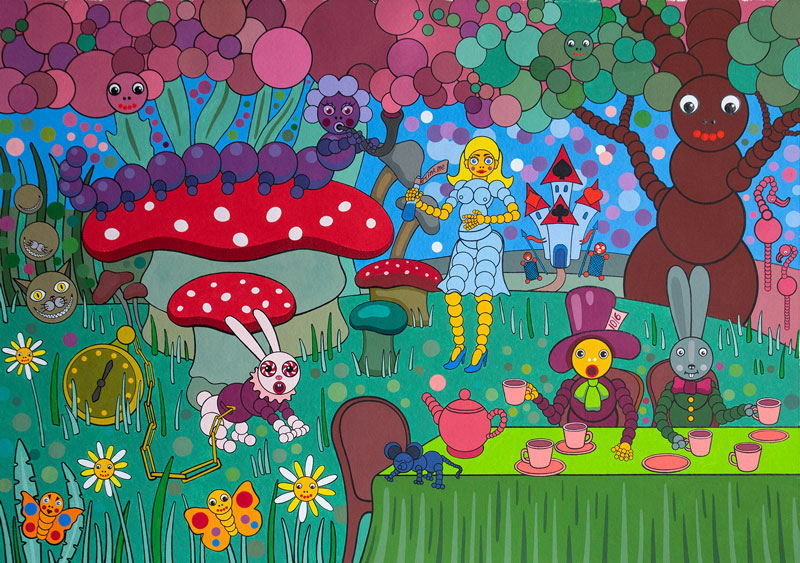
Aliceâs Adventures in Wonderland.Tinta y témpera sobre papel.2023.

How would you define your art in one word? Or better in an emoji.

It’s joy.

What is your favorite emoji?

This smiley (the artist points towards a painting behind himself).

What are the requirements for the characters of stories or famous works that you endow with a new life? What should they suggest to you or how do they reach you?

My characters are funny, many of them want to get into my pictures. From the world of Plato's ideas, heroes go to different outdoors, but almost all of them want to get to me. They take a turn and they are waiting for me to capture them. Not all of them, of course, because I'm a very busy person. I create new meanings for the characters: they stop living in everyday life. I think they are much more interested in the spherical world than in their non-spherical world. I can say, sure, I don't force anyone. If the hero doesn't like it, I don't keep him. I respect their rights.
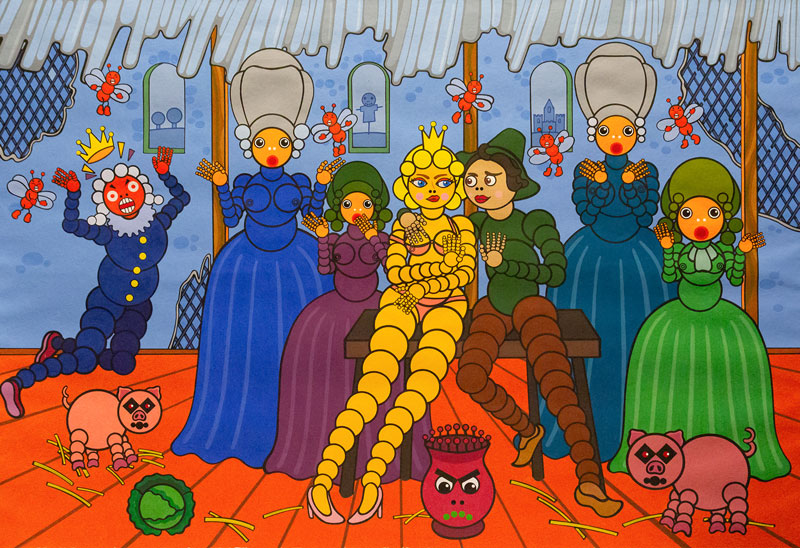
Svinedrengen. Gouache on paper. 2023.

Why the spherical, the round?

The sphere is a symbol of the universe. We all encounter spheres and circles in everyday life. Circles and spheres are the main form of my paintings. These are the stars in the sky, the atoms from which everything is made, and even money, the coins with which we pay took their form in the process of evolution, because everything tends towards the sphere. My task is to speak the language of spherism, to promote this knowledge to the people.

It was not for nothing that Hokusai wrote in his lost letter to Hiroshige on the road from Rome to Edo to Kyoto, "Suncityboy, if the future embodiment of world spherism, the personification of modernism through imaginism.”

The letter was stolen from his workshop because it had value for world culture.

Do we take everything too seriously?

The seriousness of our world is evidenced by the constant dispute of objects and forms in composition. We must understand that everything is much more serious than we think. There is a constant confrontation between forms. Circles have always competed with triangles for the main rights in composition. We see this in the images of ancient Egypt. Then they were joined by squares. A square character often creeps into my paintings. He tries to dispute the spherical harmony. But, to his great regret, he makes the composition more successful. You just have to look for it.
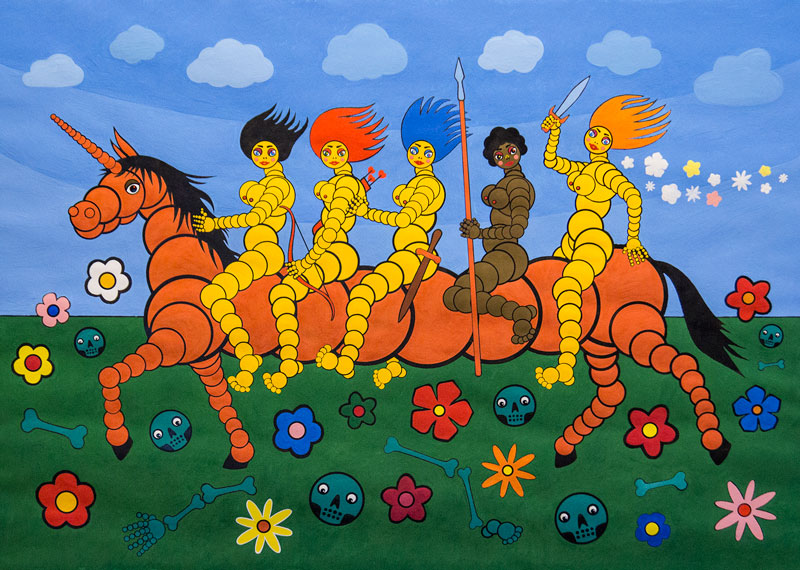
Amazons. Gouache on paper. 2023.

Drama or comedy?

The subjects of the paintings of spherical imaginism show the relationship of particles, shapes, and ideas. Characters can be both the meaning and the category of cognition. This is similar to the metamorphosis of temporary spatial transformations, when a character becomes an object and nature becomes a thing. This is the drama of the works. But at the same time, it's also comical because of this metaphor.
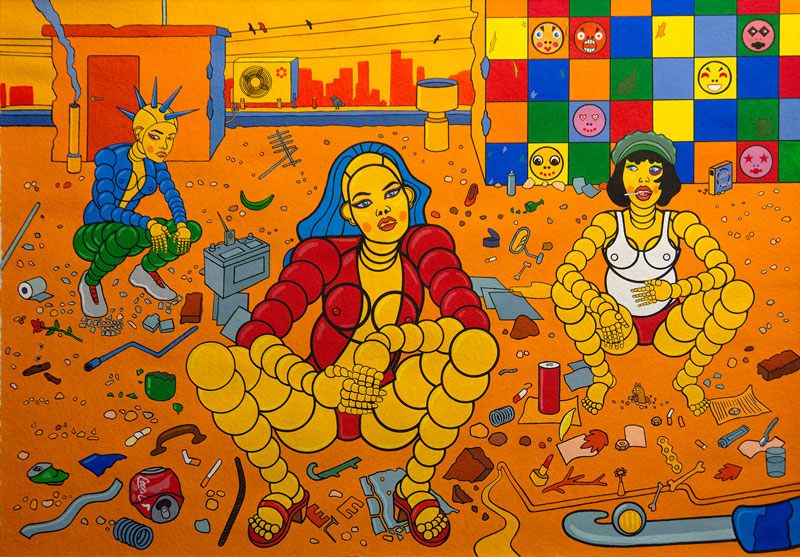
Roof Girls. Gouache on paper. 2023.

What role does music play in your creative process, I understand it is important.

Music is a circle of vinyl. It penetrates into all beings like neutrinos. Without music, it's difficult to achieve a good result. If you don't have a music player, you need to add something of yourself with your inner feeling.

You can imagine yourself with a large cello or saxophone. Music is the building material of creativity. In my case, these are bright-colored construction balls. Sometimes they turn into caramels.

Where is your art going (You can answer with an emoji if you wish) 😉

My art is moving into the future. It looks like a large spherical airplane. On board are my favorite heroes. I will appear as captain sometime during the flight. I walk between the isles and serve them drinks and treats. I think you can see this for yourself.

Thank you very much, Carlos. 😉


ART MADRID’26 INTERVIEW PROGRAM. CONVERSATIONS WITH ADONAY BERMÚDEZ


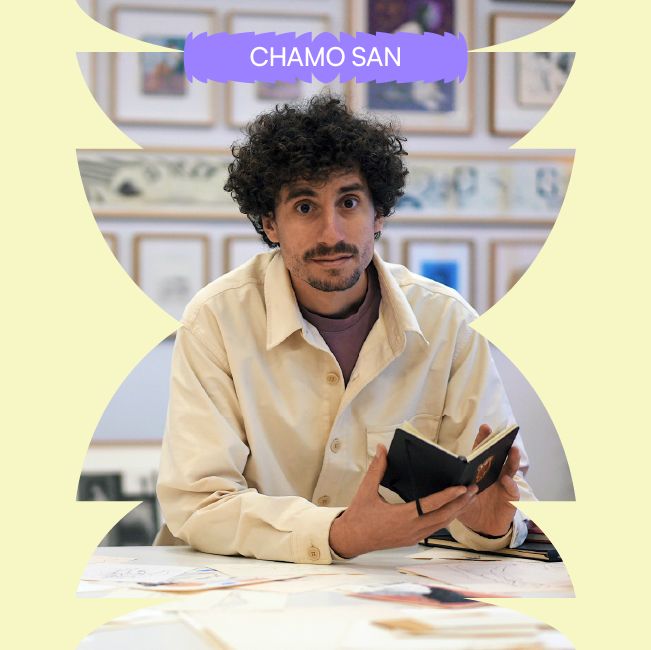
The artistic practice of Chamo San (Barcelona, 1987) revolves around a poetics of attention, in which the seemingly insignificant acquires a singular reflective intensity. His works emerge from a persistent observation of everyday life, understood not as a narrative repertoire but as a field of shared experience. Within this framework, the minimal gesture becomes a form of sensitive knowledge, placing the viewer before scenes that are both recognizable and, at the same time, estranged by their temporal suspension.

The progressive shift toward a more atmospheric painting has allowed the environment to cease functioning as a mere support and become an active agent of meaning. Restrained color ranges and carefully constructed spaces generate a sense of stillness that evokes a pictorial tradition attentive to duration and waiting. The human figure—a constant presence in his work—is presented immersed in contexts that amplify its affective and existential dimension.

The silence permeating these images is not absence but condition; it constitutes a space of resonance in which the time of doing and the time of looking converge. Situated between compositional control and openness to the contingent, Chamo San’s work affirms painting as a territory where planning and accident coexist.


Bathtub. 2018. Ballpoint pen on notebook. 14 x 18 cm.


Many of your works show meticulous attention to the smallest gestures and seemingly trivial moments. What interests you about these micro-choreographies of everyday life?

The seed of my work always comes from the sketches I make from life in small notebooks that I can carry with me at all times. Later, I either transfer them to another format so I can work on them more calmly, or they become the final piece in themselves.

Composition, staging, and perhaps those micro-choreographies are what I allow myself to bring to the scene as an artist. For me, these everyday moments are the most direct and honest way to connect with the audience because—even though they are intimate—they reflect universal experiences.


Feet. 2023. Oil pastel on paper mounted on board. 30 x 30 cm.


In your pieces, the presence of sober tones seems to generate a particular type of atmosphere. How would you describe the way that atmosphere emerges during your work, and what role does it play in the overall construction of the image?

Atmosphere and colour are relatively recent additions to my work. Previously, I focused exclusively on the figures as the central element, and they were often left floating in a kind of void. It was when I realised the need to provide context—especially as I began working more closely from the notes in my notebooks—that I came to understand the importance of the environment for the character.

The human figure will always remain the main element for me, as it is through its representation that I find the greatest enjoyment. However, little by little, I have become interested in exploring what surrounds it. I see the creation of an environment and an atmosphere as essential in order to situate the figures within a more complete and fully constructed scene.


Mamant. 2025. Colored pencils on notebook. 14 x 18 cm.


Are the silences in your works inherited from real experiences, or do they emerge during the painting process?

The silences in my work are inherited from real experiences. When I capture those small moments of everyday life—which is essential for me—I tend to be focused and quiet. At the same time, I also believe that the contemplation of artworks naturally invites this kind of calm. In that sense, for a brief moment, both the artist—throughout the entire creative process—and the viewer, when engaging with the work, can meet in the same state of tranquillity and silence.


The Kiss. 2024. Oil pastel on notebook. 14 x 18 cm.


To what extent do you plan your works and how much space do you leave for the unexpected to happen?

Some of my works are very planned, even excessively so, with lots of sketches. On the other hand, I always have that starting point that appears in my notebooks, and I leave experimentation and the unexpected for the end. Although it's also true that when I've thrown myself into improvisation from the beginning, wonderful things have happened, so now I try to combine those two worlds as organically as possible.


Cinema. 2025. Ballpoint pen and oil pastel on notebook. 14 x 18 cm.


Although your work has shifted towards the pictorial—with an aesthetic closely linked to cinema—echoes of illustration can still be seen in your visual language. Which elements would you say remain, and which have undergone a radical transformation?

For me, illustration has been an intense learning process. I deeply admire artists who have combined commissioned illustration with studio work for galleries, such as Ramón Casas and James Jean. I believe these two worlds can connect on a technical level, but their language and purpose are fundamentally different.

The existence of a unique, original work allows for accidents to occur—things that are very unlikely to happen in illustration. It is this condition of uniqueness, and above all the intention behind it, that makes the two practices radically different.